Overview
Trip.com is an online travel agency that allows users to select up to three saved hotels and compare them with AI. I redesigned this feature into a more guided decision-making experience by helping users narrow a long shortlist, capturing missing travel context, and dynamically reorganizing comparison criteria for different types of travelers.
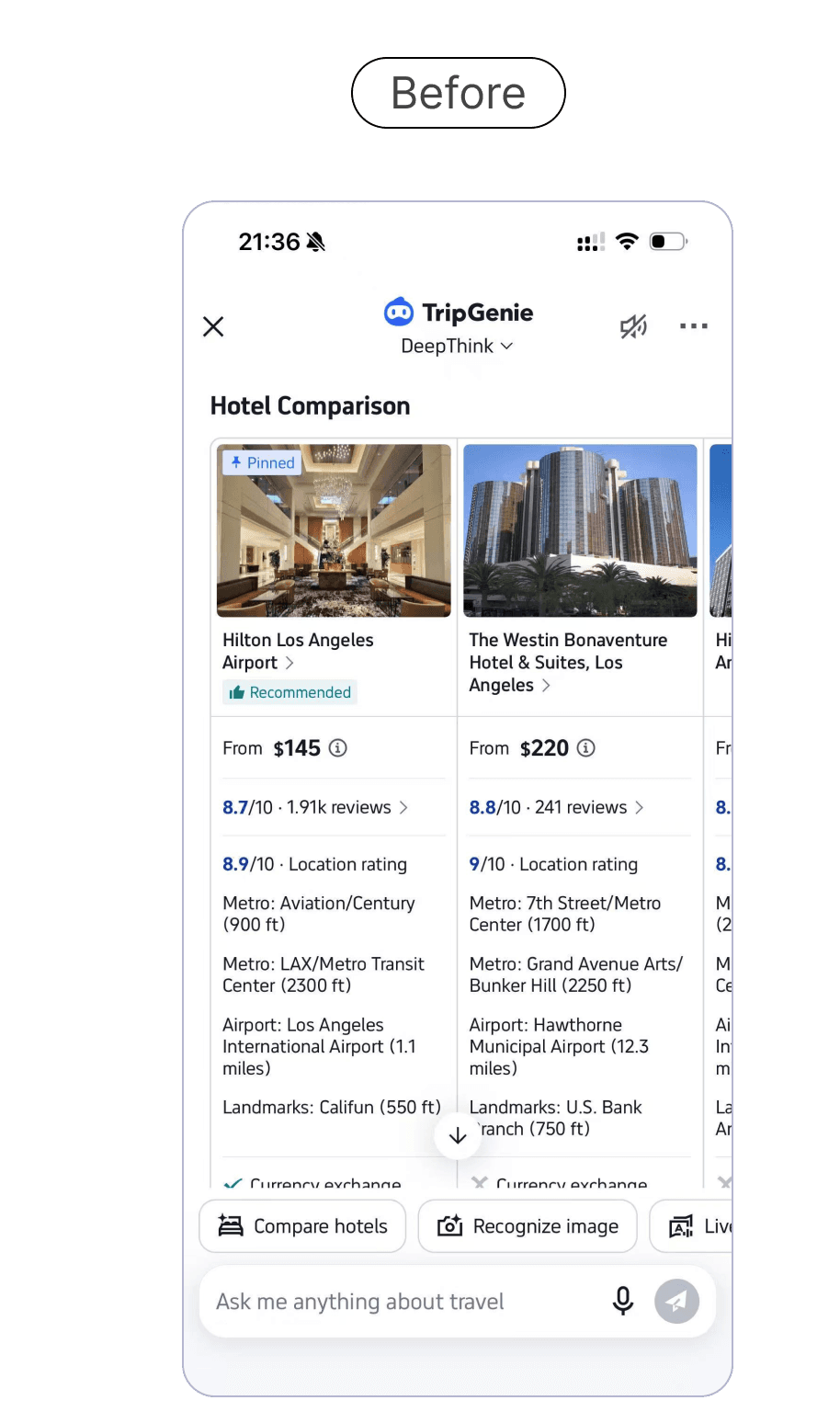
Original User Flow for Hotel Comparison
The Paradox of Choice: Users often save far more than three hotels, making the initial selection for comparison overwhelming.
One-Size-Fits-All Metrics: Current comparisons show the same dimensions to everyone, while families, business travelers, and groups prioritize different tradeoffs.
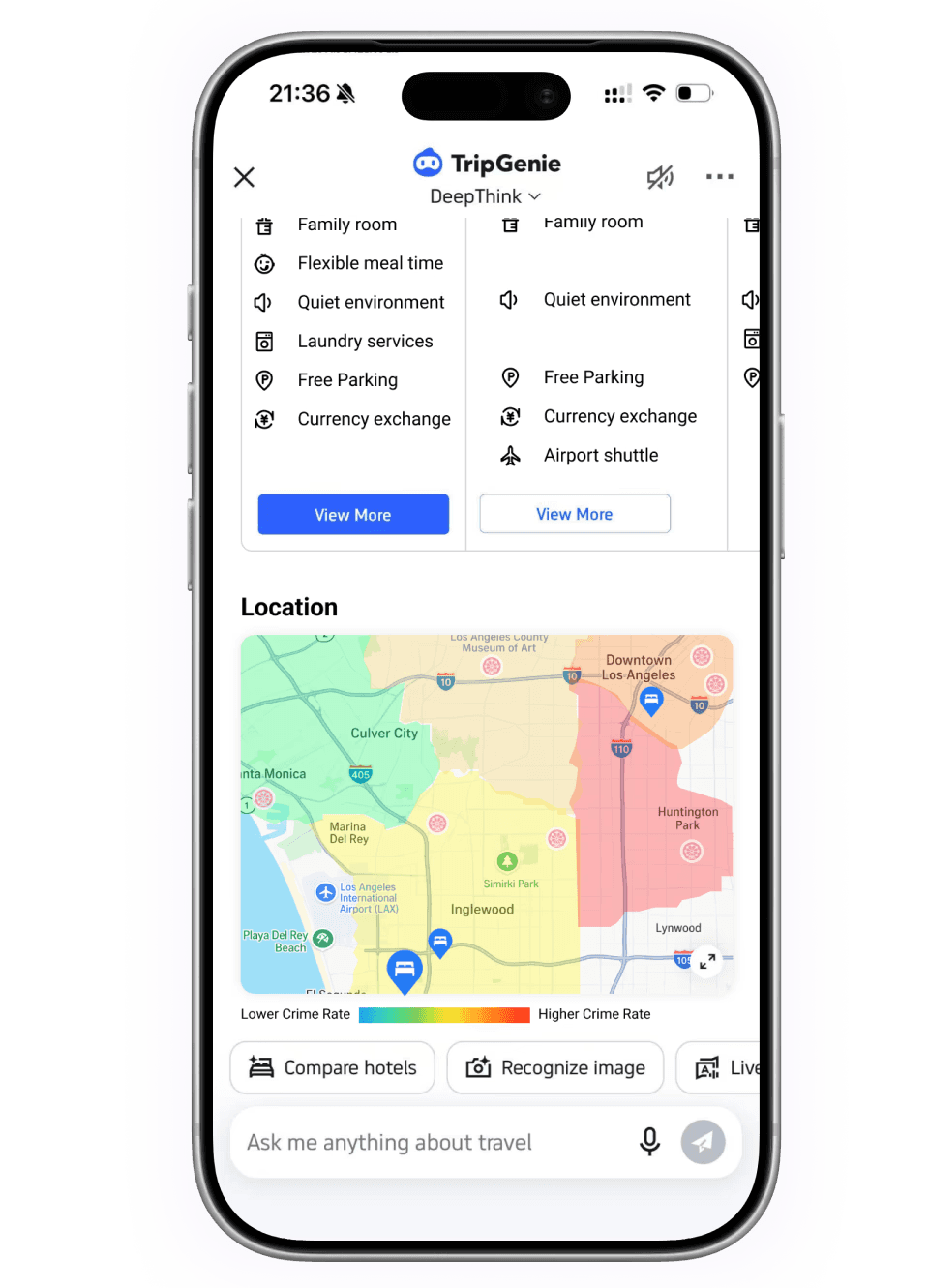
Location Blindness: Distance alone misses context. Users struggle to judge neighborhood safety, convenience, and the actual walking experience.
The Trust Deficit: Users cross-reference reviews outside the app to verify claims about noise, cleanliness, and safety before booking.
Current competitors largely remain at the information comparison level, lacking cross-platform trust integration and personalized decision support. AI has yet to play a meaningful role in the final decision-making process.
I interviewed 12 travelers to understand how they compare and choose hotels.
I spoke with solo travelers, couples, families, and business travelers with different booking habits. The interviews focused on how they build a shortlist, compare similar hotels, interpret reviews, and make a final decision.
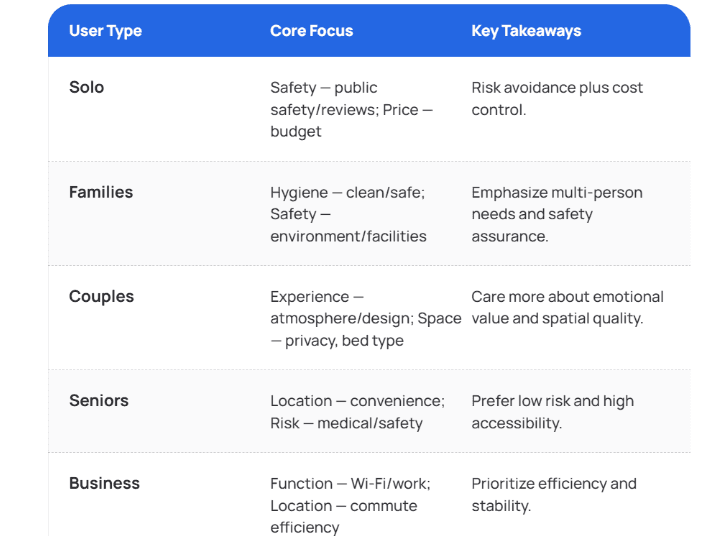
User Segmentation Summary
Safety — public safety/reviews; Price — budget
Safety — public safety/reviews; Price — budget
Risk avoidance plus cost control.
Risk avoidance plus cost control.
Hygiene — clean/safe; Safety — environment/facilities
Hygiene — clean/safe; Safety — environment/facilities
Emphasize multi-person needs and safety assurance.
Emphasize multi-person needs and safety assurance.
Experience — atmosphere/design; Space — privacy, bed type
Experience — atmosphere/design; Space — privacy, bed type
Care more about emotional value and spatial quality.
Care more about emotional value and spatial quality.
Location — convenience; Risk — medical/safety
Location — convenience; Risk — medical/safety
Prefer low risk and high accessibility.
Prefer low risk and high accessibility.
Function — Wi‑Fi/work; Location — commute efficiency
Function — Wi‑Fi/work; Location — commute efficiency
Prioritize efficiency and stability.
Prioritize efficiency and stability.
Based on secondhand data analysis and user behavior clustering. In addition to industry reports and academic research, real discussions and reviews from social platforms such as Xiaohongshu and Reddit were also analyzed.
Solution: Tag-Based Shortlisting
Users select three hotels from their saved list for comparison.
Users select three hotels from their saved list for comparison.
Based on secondhand data analysis and user behavior clustering. In addition to industry reports and academic research, real discussions and reviews from social platforms such as Xiaohongshu and Reddit were also analyzed.
I introduced filter tags to help narrow down options faster while capturing signals about each user’s travel priorities and trip context.
These preferences are then carried into the next step to shape a more personalized hotel comparison.
Solution: Pre-Chat Context Check
After selecting three hotels, users enter the AI chat to compare them
After selecting three hotels, users enter the AI chat to compare them
Before starting the AI conversation, users answer a few lightweight questions to confirm their trip type. This context helps the AI prioritize the most relevant comparison criteria from the start. If the trip type has already been identified earlier in the flow, the system skips these questions to avoid repetition.
Solution: Floating Best Match
The comparison table pins the best-matched hotel to the left, keeping it visible as users swipe horizontally through other options. This makes side-by-side comparison easier and helps users evaluate trade-offs without losing their recommended reference point.
Solution: Context-Adaptive Comparison
The comparison table pins the best-matched hotel to the left, keeping it visible as users swipe horizontally through other options. This makes side-by-side comparison easier and helps users evaluate trade-offs without losing their recommended reference point.
The comparison table dynamically adjusts its criteria based on the user’s trip type, such as Family, Business, Couple, or Solo.
Instead of a text-heavy layout, icons and highlights make each hotel’s fit across key dimensions easier to scan, helping users quickly identify strengths, trade-offs, and the best match.
Instead of a text-heavy layout, icons and highlights make each hotel’s fit across key dimensions easier to scan, helping users quickly identify strengths, trade-offs, and the best match.
Solution: Contextual Map View
The comparison table dynamically adjusts its criteria based on the user’s trip type, such as Family, Business, Couple, or Solo.
Instead of a text-heavy layout, icons and highlights make each hotel’s fit across key dimensions easier to scan, helping users quickly identify strengths, trade-offs, and the best match.
After users select their hotels, a mini map automatically plots each option to reveal their spatial relationship. It also surfaces nearby safety conditions, transit accessibility, and entertainment amenities, helping users evaluate the surrounding context beyond the hotel itself.
Comparison Efficiency — Time to reach a final hotel choice
Personalization Effectiveness — Usage of tags and personalized recommendations
Decision Confidence — User confidence after completing the comparison
Trust in Recommendations — Perceived trust in AI and cross-platform review summaries
Comparison Efficiency — Time to reach a final hotel choice
Personalization Effectiveness — Usage of tags and personalized recommendations
Decision Confidence — User confidence after completing the comparison
Trust in Recommendations — Perceived trust in AI and cross-platform review summaries